
From Curiosity to Creation
A graduate of Western Technical College’s Business Management program, Thomas Nichols has always been curious about turning ideas into something real.
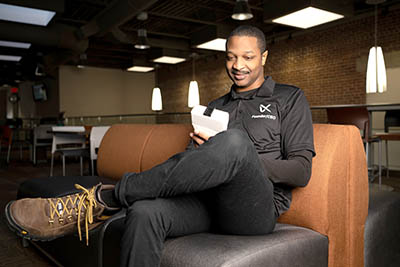
Q & A with Western Graduate and Visorix Founder Thomas Nichols
Hot off the press! Since this interview, Nichols’ work has continued to gain momentum. Visorix is moving into the next phase of product development, with a formal business launch and product debut scheduled at the La Crosse Center. The company will also be featured on Project Pitch It, bringing additional visibility to the work. As the project grows, it reflects more than one person’s idea—it’s a real-time example of how Western’s hands-on learning, facilities, and connections can help students turn ideas into something tangible.
A graduate of Western Technical College’s Business Management program, Thomas Nichols has always been curious about turning ideas into something real. A photographer with a knack for technical problem-solving, Nichols combines creativity with relentless persistence. Today, as the founder of Visorix, he is developing Virtara—an accessible virtual reality camera designed to help creators tell immersive stories without the high cost and complexity that often with new technology. His journey reflects the practical, hands-on learning that defines a Western education and how it ripples far beyond the classroom, which is very much the point.
Why did you choose to study business at Western Technical College?
My first passion was photography, but at the time, a two-year photography degree wasn’t an option. Before coming to Western, I had been exploring creative ideas through pitch competitions, which are common in entrepreneurship. Those experiences were encouraging, but they also showed me something important—I didn’t yet understand how businesses actually work.
I chose Business Management at Western because I wanted a strong, practical foundation. Once I started, everything clicked. The instructors made the material approachable and real-world focused. I gained the tools I needed to understand how ideas move from concept to reality.
How has your business education shaped the way you think about building products today?
I tend to look at a product from the ground up—thinking through costs, who it’s for, how it will be marketed, and what legal considerations might come into play. In many ways, it’s similar to how I approach photography. When you take a photo, you’re considering lighting, exposure, aperture, and your subject all at once. Business works the same way for me. You have to consider all the elements together to understand whether an idea is truly viable.
Are there lessons from Western that show up more often than you expected?
I regularly draw on what I learned about funding. Western helped me understand that if you don’t have personal resources to rely on, you need to know how venture capital or crowdfunding work. Even the human resources classes stuck with me. I still use tools from those courses when thinking through hiring and writing job descriptions.
How did your military service change your perspective?
The discipline I gained through the military has a major impact on how I approach life and work. It taught me not to give up on the things I care about and to keep moving forward, even when challenges arise. The military instills a strong sense of mission accomplishment—the idea that you find a way to get the job done, regardless of the circumstances. That mindset has carried over directly into running a startup.
What about your roots as a photographer. What originally drew you this art form?
When I was growing up, my family went to Disney World. My mom wanted to get a picture taken, and later she had it printed as an 8 x 10. I remember looking at that photo and suddenly being able to recall the entire day—from when we woke up, to the food we ate, to the moment we went to bed. That experience stuck with me. I realized I wanted to be able to create moments like that for other people—to capture not just an image, but a full memory. That’s why I chose photography, and it’s why I keep coming back to it. It’s always been my first love.
Virtara began with a realization that VR creation was too expensive. How did that turn into action?
I was trying to create a VR video myself and quickly realized how difficult the process was—you almost needed a degree just to make a simple clip. I started looking for ways to do it without spending a huge amount of money and discovered that, with some experimentation, it was possible.
That experience showed me that immersive video didn’t have to cost thousands of dollars. Around the same time, I came across industry research that pointed out a major challenge: there simply wasn’t enough VR content available. That was my eureka moment. I realized I had the skills to help solve a problem that even the largest tech companies were still trying to figure out.
You’ve attracted interest from major technology companies recently. What does that mean to you?
It’s definitely validating! It tells me that the data-driven approach I’ve taken is on the right track and that I’ve identified a real need in the market. That kind of interest confirms that what we’re building is resonating and moving in the right direction.
When you imagine the future of Virtara, what does success look like?
Success, to me, looks like people using this device as a tool to create content they can build a living from—much like creators do on YouTube today. Back in 2005, no one could have predicted what that platform would become. It started simply and grew because people were given the tools and freedom to create.
I want that same kind of opportunity for Virtara users—starting on a level playing field and using the technology in creative, unexpected ways to make immersive videos you can truly feel. That’s what success looks like to me.